
Effective digital advertising requires selecting Call to Action buttons that align with audience intent and marketing goals. Strategic choices range from low-friction options for brand awareness to direct commands for e-commerce. Emerging conversational CTAs via messaging platforms are increasingly effective for building trust and closing sales with local audiences.
Successful campaigns match button wording to the user’s stage in the sales funnel and ensure landing pages provide promised content. Maintaining this alignment prevents algorithmic penalties and high costs. Advertisers should allow campaigns sufficient time to gather data before modifying buttons to avoid disrupting the platform’s automated learning process.
The Power of the Push: A Guide to Choosing the Right CTA for Your Business
In the world of digital advertising, we spend a lot of time obsessing over “The Big Stuff”—high-end video production, complex audience targeting, and multi-channel budgets. But at the end of the day, your entire campaign often boils down to a single, small rectangle: the Call to Action (CTA) button.
In 2025, the CTA is no longer just a “Submit” button. It is a strategic tool that tells both the user and the algorithm exactly what should happen next. Choosing the wrong one is like inviting someone for a coffee but then asking them for a loan the moment they sit down—it’s jarring, and it kills the mood.
Here is your guide to the most effective CTAs, when to use them, and how to make them work for your business.
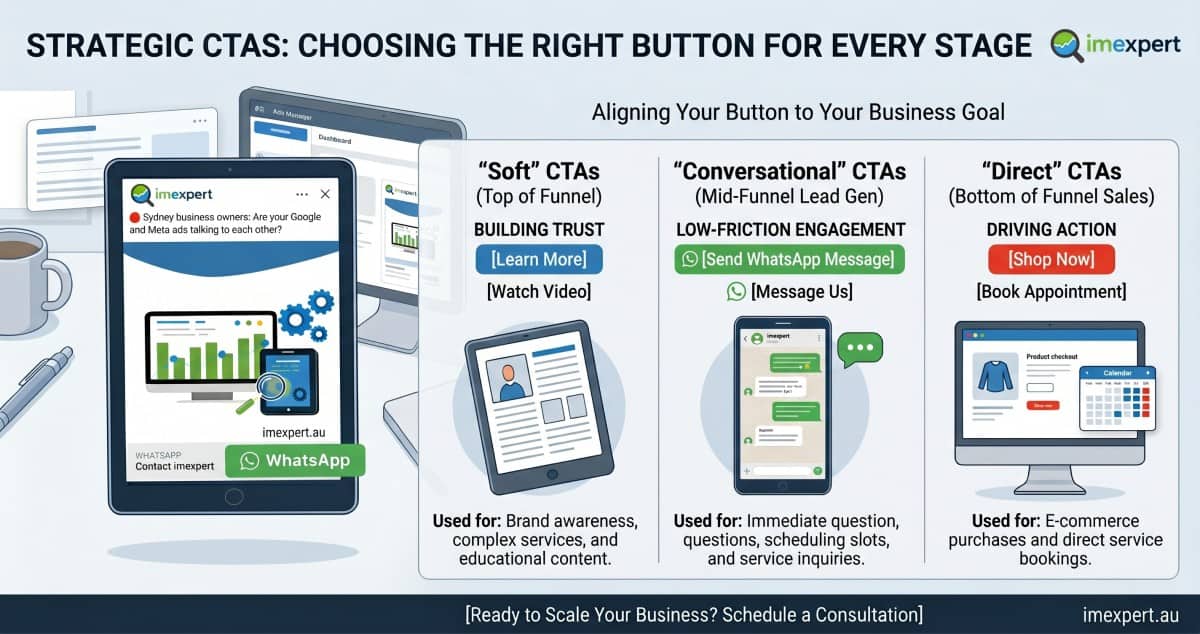
The “Soft” CTAs: Building Trust
These are best used for Top-of-Funnel campaigns where the audience might not know you yet. You aren’t asking for a marriage proposal; you’re just asking for a second date.
- Learn More: This is the most versatile CTA on the internet. Use it when your product requires a bit of “heavy lifting” or education before a sale.
- Best for: High-ticket services, complex software, or new brand stories.
- Watch More: Perfect for video-first campaigns on YouTube or Meta.
- Best for: Product demos, brand documentaries, or testimonial reels.
The “Direct” CTAs: Closing the Deal
When the user knows what they want and they’re ready to pull the trigger, don’t stand in their way. Be direct.
- Shop Now: The gold standard for e-commerce. It’s clear, concise, and carries a high intent to purchase.
- Best for: Physical products, limited-time sales, and retargeting known shoppers.
- Book Now / Get Quote: These are the bread and butter for service-based SMBs. They signal a move from “browsing” to “doing.”
- Best for: Gyms, consultants, tradies, and professional services.
The “Conversational” CTAs: The 2026 Powerhouse
We are seeing a massive shift towards Conversational Commerce. People don’t always want to fill out a 10-field form; they want to ask a quick question.
- Send WhatsApp Message: As seen in modern Meta Ads, this is incredibly effective for local businesses. It lowers the “barrier to entry” because most people find messaging more natural than calling or emailing.
- Message Us: Similar to WhatsApp but stays within the platform (Facebook/Instagram).
- How to use it: Use these for high-touch services where a quick chat can overcome an objection (e.g., “Do you have any slots available this Tuesday?”).
How to Use CTAs Strategically
Choosing the button is only half the battle. To make it work, you need to follow these three rules:
A. Match the “Temp” to the “Button”
Don’t use “Sign Up” for a cold audience who has never seen your brand. Start with “Learn More”. Conversely, if you’re retargeting someone who has visited your pricing page three times, move to “Book Now”.
B. Keep the Destination Relevant
The biggest mistake SMBs make is sending every CTA to their homepage.
- If the button says “Shop Now”, the user should land on a product page.
- If it says “Get Quote”, they should land on a page with a quote form.
C. Watch for the “Mismatch Penalty”
While we want to be creative, the algorithms (the “robots” at Google and Meta) are watching. If your button promises one thing (e.g., “Download Guide”) but the landing page asks for something else (e.g., “Buy My Course”), the algorithm will flag the ad as low-relevance. This leads to higher costs and fewer people seeing your ad.
The Verdict: Which button should you click?
There is no “one size fits all” button, but there is always a “right” button for your specific goal. If your objective is lead generation, “Send WhatsApp Message” or “Get Quote” are currently outperforming almost everything else for SMBs due to their low friction.
| Type | CTA Button | Suggested Use Case | Strategic Tip |
| Soft (Awareness) | Learn More | Best for high-ticket services or new products that require education. | The highest CTR button. Use for blog posts or “About Us” pages. |
| Watch More | Use for brand storytelling or testimonial-heavy video campaigns. | Ideal for Top-of-Funnel (TOF) video views to build an audience. | |
| Listen Now | Perfect for podcast promotions or Spotify/audio-first content. | Ensure the landing page audio starts muted to avoid “startle” bounces. | |
| Conversational (Lead Gen) | Send WhatsApp Message | Best for local service businesses where a quick chat closes the deal. | Massive growth in 2026; lower friction than a traditional website form. |
| Message Us | Ideal for Instagram-heavy brands looking to build a community. | Great for answering quick objections before a user commits. | |
| Contact Us | Use for general inquiries or B2B services with a long sales cycle. | A safe “middle-ground” button that feels professional and helpful. | |
| Direct (Sales/Action) | Shop Now | The standard for e-commerce and direct product sales. | High intent; ensure it leads to a specific product, not the homepage. |
| Book Now | Perfect for gyms, clinics, and appointment-based businesses. | Pair with an “Add to Calendar” function on the thank-you page. | |
| Get Quote | Best for high-value service businesses (Tradies, Solar, Finance). | Highest quality lead button. Implies a serious intent to buy. | |
| Sign Up | Use for newsletters, SaaS free trials, or webinar registrations. | Users expect a very short form (usually just an email) after this click. | |
| Download | Best for lead magnets like PDFs, eBooks, or price lists. | Essential for “value-first” marketing where you trade info for an email. |
Is your ad strategy properly aligned?
At imexpert, we specialise in making sure your “golden thread”—from the first ad impression to the final click—is perfectly optimised. Whether it’s choosing the right CTA or ensuring your Meta and Google ads are actually talking to each other, we’re here to help.
Ready to see better results from your ad spend? Contact imexpert Today for a strategy session.
Which CTA button is objectively “the best” for conversions?
There isn’t a single “magic” button, but statistics in 2026 show that “Learn More” consistently sees the highest click-through rate (CTR) because it feels low-risk to the user. However, “Shop Now” or “Book Now” usually results in higher-quality leads. The “best” button is the one that most accurately describes the very next step the user will take.
Can I use different CTAs for the same ad?
Yes, and you probably should. If you are using Advantage+ Creative on Meta, you can select the “Multiple CTAs” option. Meta’s AI will then look at a user’s past behaviour—showing “Message Us” to someone who frequently uses Messenger, while showing “Shop Now” to someone who is a frequent impulse buyer. It’s a great way to let the algorithm do the heavy lifting.
Why does my CTA button look different on Instagram compared to Facebook?
Meta automatically adapts the appearance of your CTA to fit the “vibe” of the platform. On Instagram Stories, it might be a “Swipe Up” or a translucent pill at the bottom. On the Facebook Feed, it’s a standard button. You don’t need to worry about the design; just focus on the wording—the platform handles the aesthetics.
Why isn’t the “Send WhatsApp Message” button showing as an option?
Directly? No. Indirectly? Absolutely. If you choose “Shop Now” but send people to a long-form blog post, users will click and immediately leave (bounce). The algorithm sees this high bounce rate, marks your ad as “Low Quality”, and then charges you more to show it because it’s providing a poor user experience.
Should I use “Shop Now” even if I’m just trying to get people to browse?
We wouldn’t recommend it. “Shop Now” implies an immediate financial transaction. If a user isn’t ready to buy, they might avoid clicking altogether. If your goal is browsing or “window shopping,” “View More” or “Learn More” feels much more inviting and usually results in a lower cost-per-click.
How long should I wait before changing a CTA that isn’t working?
Avoid the temptation to “tinker” too early. Every time you change a CTA, you might reset the Learning Phase of the algorithm. We recommend letting an ad run for at least 7 days or until it has reached roughly 1,000 people before deciding if the button is the problem.